The CHAT Method: The Four Elements of Effective Cleaning
Jul 23, 2026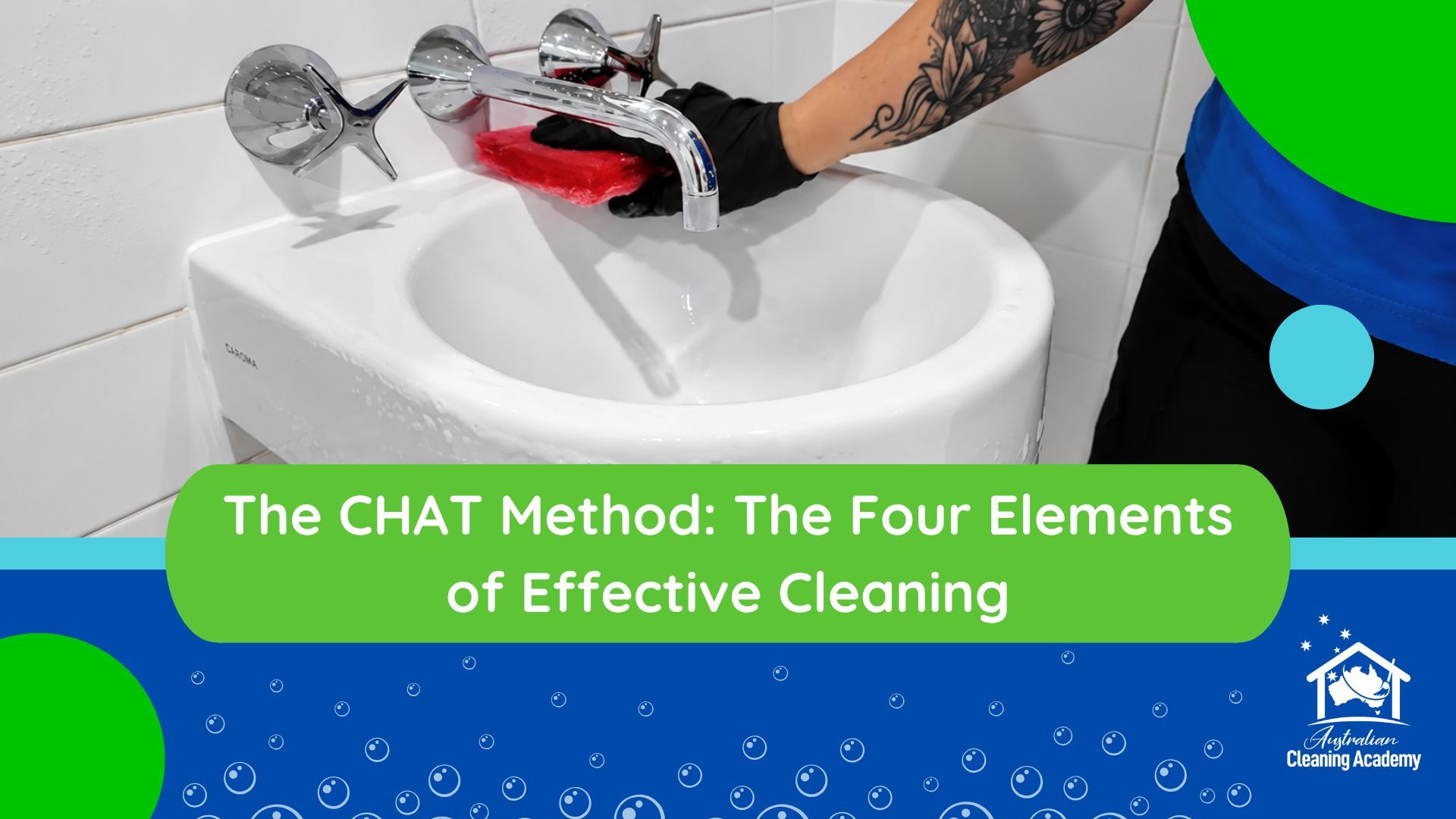
Have you ever wondered why one cleaning product works brilliantly in one situation but seems ineffective in another?
The answer often isn't the product itself—it's how it's being used.
At Australian Cleaning Academy, we teach a simple but powerful framework called the CHAT Method.
CHAT stands for:
- C – Chemical
- H – Heat
- A – Agitation
- T – Time
These four elements work together to achieve an effective clean.
If one element is reduced, another needs to increase to compensate.
Understanding this balance is one of the biggest differences between simply wiping a surface and cleaning it professionally.
Why the CHAT Method Works
Cleaning isn't magic.
Whether you're removing grease from a kitchen bench, soap scum from a shower screen or grime from a commercial floor, you're relying on four factors working together.
Think of them as four controls that can be adjusted depending on the cleaning task.
Sometimes you need more chemical.
Sometimes you need more scrubbing.
Sometimes you simply need to give the product more time to do its job.
Professional cleaners don't rely on luck—they adjust the balance.
C = Chemical
The first element is the cleaning chemical.
Different soils require different chemicals, and choosing the right product is important.
A quality cleaning chemical helps break down:
- Grease
- Oils
- Soap scum
- Mineral deposits
- Food residue
- Dirt
However, more chemical doesn't necessarily mean better cleaning.
Using too much product can leave residue, create streaks and even make surfaces attract dirt more quickly.
The goal is to use the right chemical in the right amount.
H = Heat
Heat helps speed up chemical reactions and makes many soils easier to remove.
Think about washing greasy dishes.
Cold water will clean them eventually, but warm or hot water helps break down grease much more effectively.
Heat can come from:
- Warm water
- Hot water
- Steam
- Heated cleaning equipment
Not every surface can tolerate heat, so it's important to follow manufacturer recommendations.
When heat can't be used, you'll need to rely more on the other three elements of the CHAT Method.
A = Agitation
Agitation is the physical action used to loosen and remove soil.
This might include:
- Wiping
- Scrubbing
- Brushing
- Scouring
- Using a microfibre cloth
- Using a mop or pad
Many people assume the chemical does all the work.
In reality, chemicals loosen the soil, while agitation helps lift and remove it from the surface.
The amount of agitation required depends on the type of soil and the cleaning method being used.
T = Time
Time is often the most overlooked part of cleaning.
Cleaning products need time to work.
This is known as dwell time or contact time.
If you spray a surface and immediately wipe it, the chemical may not have had enough time to break down the dirt or grime.
Allowing the product to sit for the recommended time often means you can clean more effectively with less effort.
The Four Elements Work Together
The real strength of the CHAT Method is understanding that these four elements are connected.
If one element decreases, another usually needs to increase.
For example:
Eco-friendly cleaning products
Some environmentally friendly products may contain gentler ingredients.
To achieve the same cleaning result, you may need to:
- Allow more dwell time
- Increase agitation
- Use warm water where appropriate
The product can still work effectively—it simply requires a different balance of the CHAT elements.
Cleaning with cold water
Sometimes hot water isn't available or isn't suitable for the surface.
In these situations, you may need to:
- Increase agitation
- Allow more time for the chemical to work
- Select a chemical that performs well in cooler temperatures
Delicate surfaces
Some surfaces can't be scrubbed aggressively without causing damage.
Instead of increasing agitation, you might:
- Choose a more suitable chemical
- Allow a longer dwell time
- Use warm water if appropriate
There Is No Single Formula
One of the most important things to understand about the CHAT Method is that there isn't one perfect combination.
Professional cleaning is about making informed decisions.
Every cleaning task is different, and experienced cleaners adjust the balance of Chemical, Heat, Agitation and Time to suit the surface, the soil and the environment.
This flexibility is what makes the CHAT Method such a practical framework across homes, workplaces, healthcare settings and commercial environments.
Bringing It All Together
The CHAT Method is one of the core principles taught at Australian Cleaning Academy because it helps cleaners understand why a cleaning method works—not just what to do.
When you combine the CHAT Method with the 3 Level Clean, the Top Down Approach and working from the cleanest area to the dirtiest, you create a professional cleaning system that is efficient, consistent and effective.
Rather than relying on guesswork, you have a proven framework that can be applied to almost any cleaning task.
🎓 ACA Pro Tip
When something isn't coming clean, don't immediately reach for a stronger chemical.
Instead, ask yourself:
- Do I need a different Chemical?
- Can I safely add Heat?
- Do I need more Agitation?
- Have I allowed enough Time?
Thinking through the CHAT Method often helps you solve the problem without using harsher products or making the job harder than it needs to be.